Workshop 14

INSTRUCTOR

Nishant Jain

DESCRIPTION

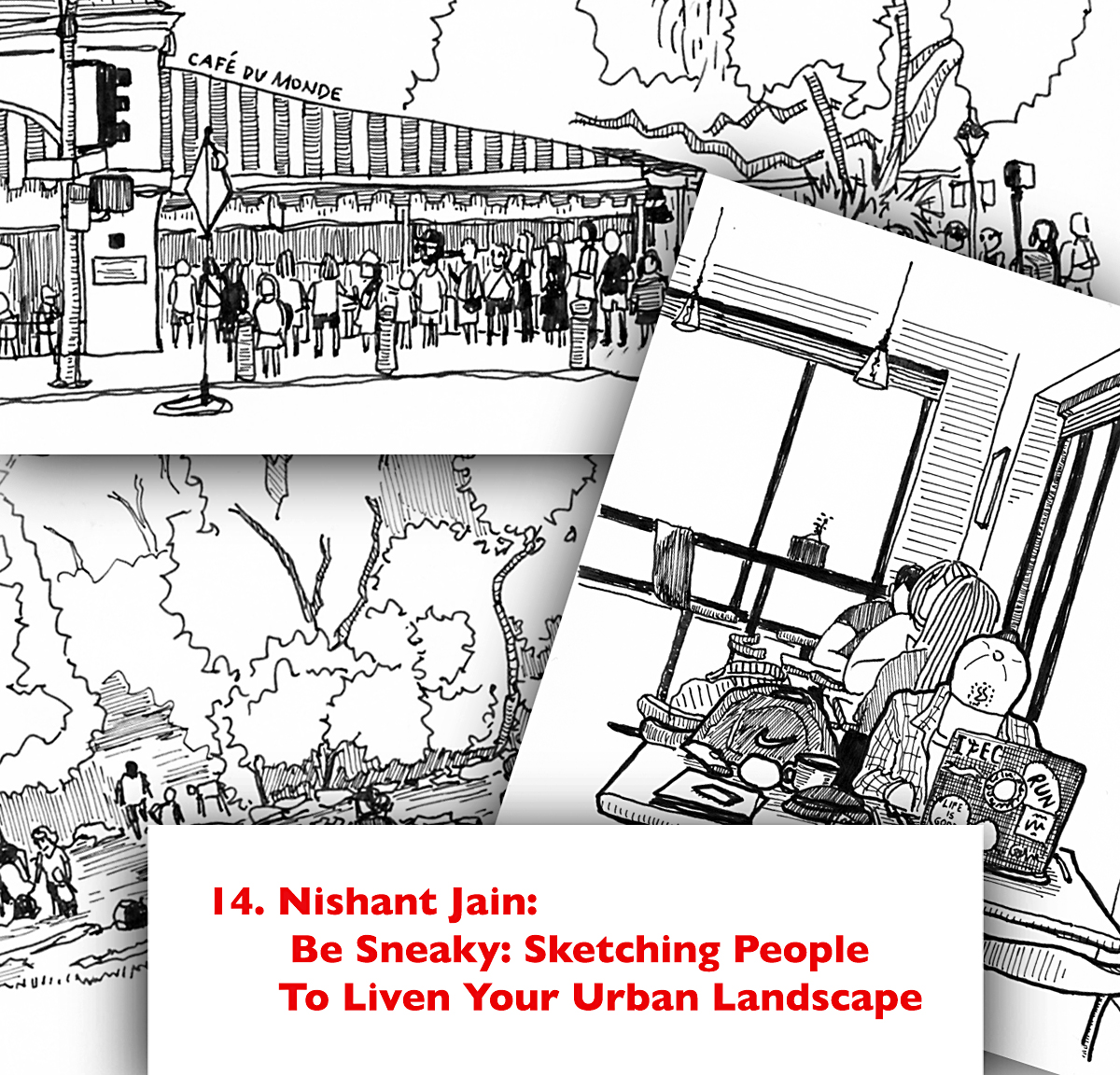
In this workshop, the subjects of our art will be the people of this great city. Watching from the shadows, we will observe closely while drawing quickly. We will be the fast and the sketchy. We will be gone in 60 seconds. A Sneaky Artist draws beauty from their immediate surroundings, without drawing attention. Like an art-ninja!

By the end of this workshop, we will see how human presence lends relevance and meaning to the urban landscape. We will see how simple linework can illustrate character and evoke personality. We will conclude with a throw-down to celebrate our collective trip through Chicago.

LEARNING GOALS

Participants will gain confidence to take a sketch from start to finish in a short amount of time. This opens up countless opportunities to sketch at airports, bus-stops, restaurants and bars, without constantly annoying one’s friends and family.

  • Minimizing linework to keep a clean page
  • Seeing the city with respect to its people
  • Selective detailing to save time and give emphasis

SUPPLY LIST

  • Sketchbook with up to 2 pens or pencils of choice. No erasers!
  • iPad users also welcome!

Workshop 13

INSTRUCTOR

Mark Jones

DESCRIPTION

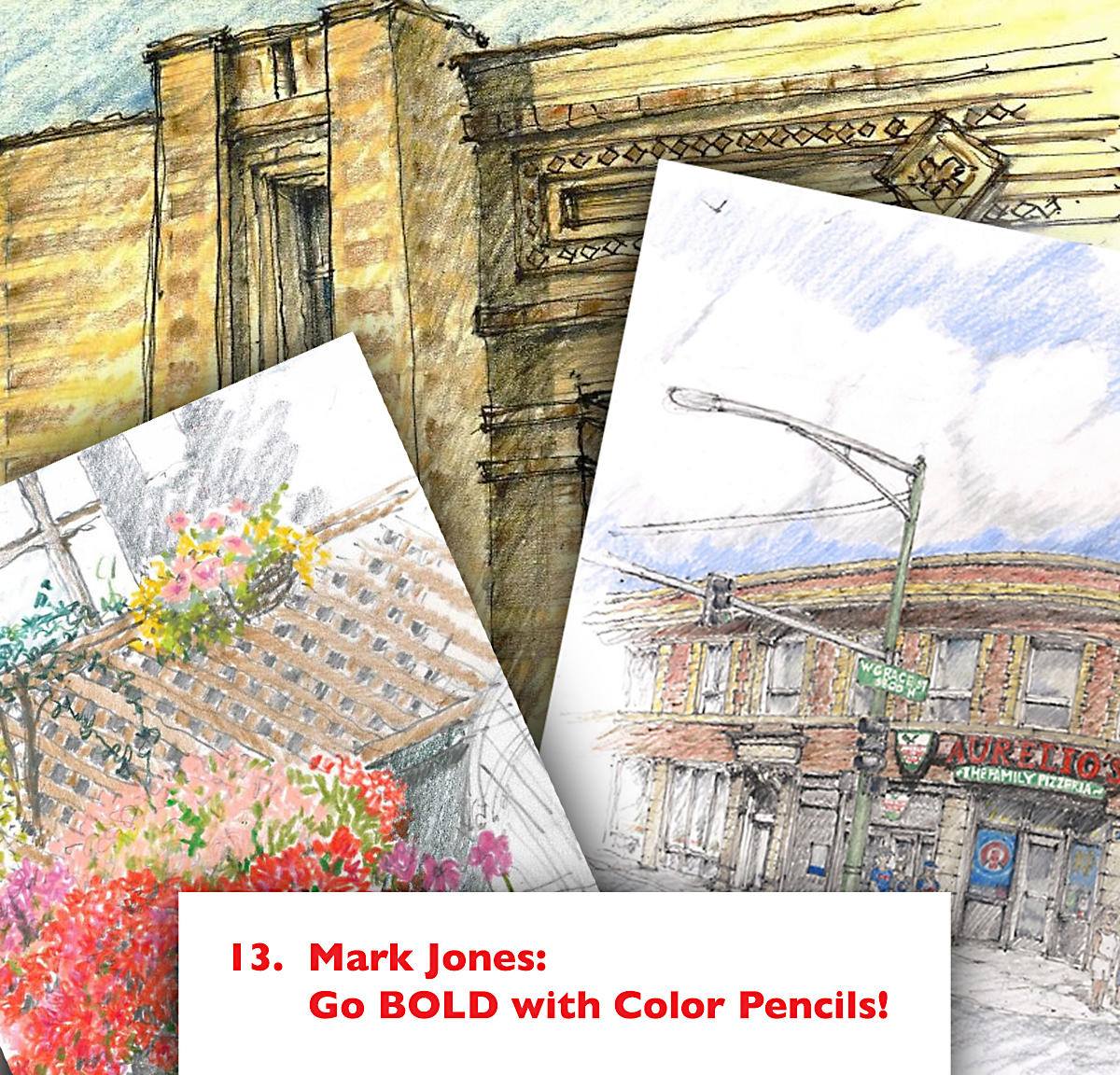
Capture boldness and vibrancy in your urban sketches utilizing color pencils and art sticks. Broaden your skills using color pencils and the use of color pencil art sticks.

LEARNING GOALS

  • Learn how the blending and layering of color pencils can bring out bold color, texture, depth, and richness in their sketches
  • Learn techniques for drawing hard and firm with color pencils and art sticks.
  • Learn blending and shading techniques of color pencils with graphite.
  • Learn techniques to sketch windows, water, and sky.
  • Learn techniques for sketching brick, stone, and field of color.

SUPPLY LIST

  • Color pencils: A minimum of a 24-pack is recommended.  Additional pencils of white, shades of blues, reds, greens, and grays.  Cream, Terra Cotta, and Burnt Orange are additional colors suitable for buildings and ornament; Caron d’Arch Luminance, Caron d’Arch Pablo, Faber-Castell Polychromos, Derwent, and Berol Prismacolor are all good brands of pencil. Art Stix:  Prismacolor, 12 pack or 24 pack.
  • Fountain Pen
  • Sketchbook or pad of paper, minimum A5 size.  Smooth grained paper is preferred but not required.
  • Graphite pencils: Various lead weights from soft to hard; 4B, 2B, HB, 2H, and 4H.
  • Pencil sharpener
  • Small stool or chair (optional)

I will bring numerous spare color pencils for participants to use.

Workshop 12

INSTRUCTOR

Marek Badzynski

DESCRIPTION

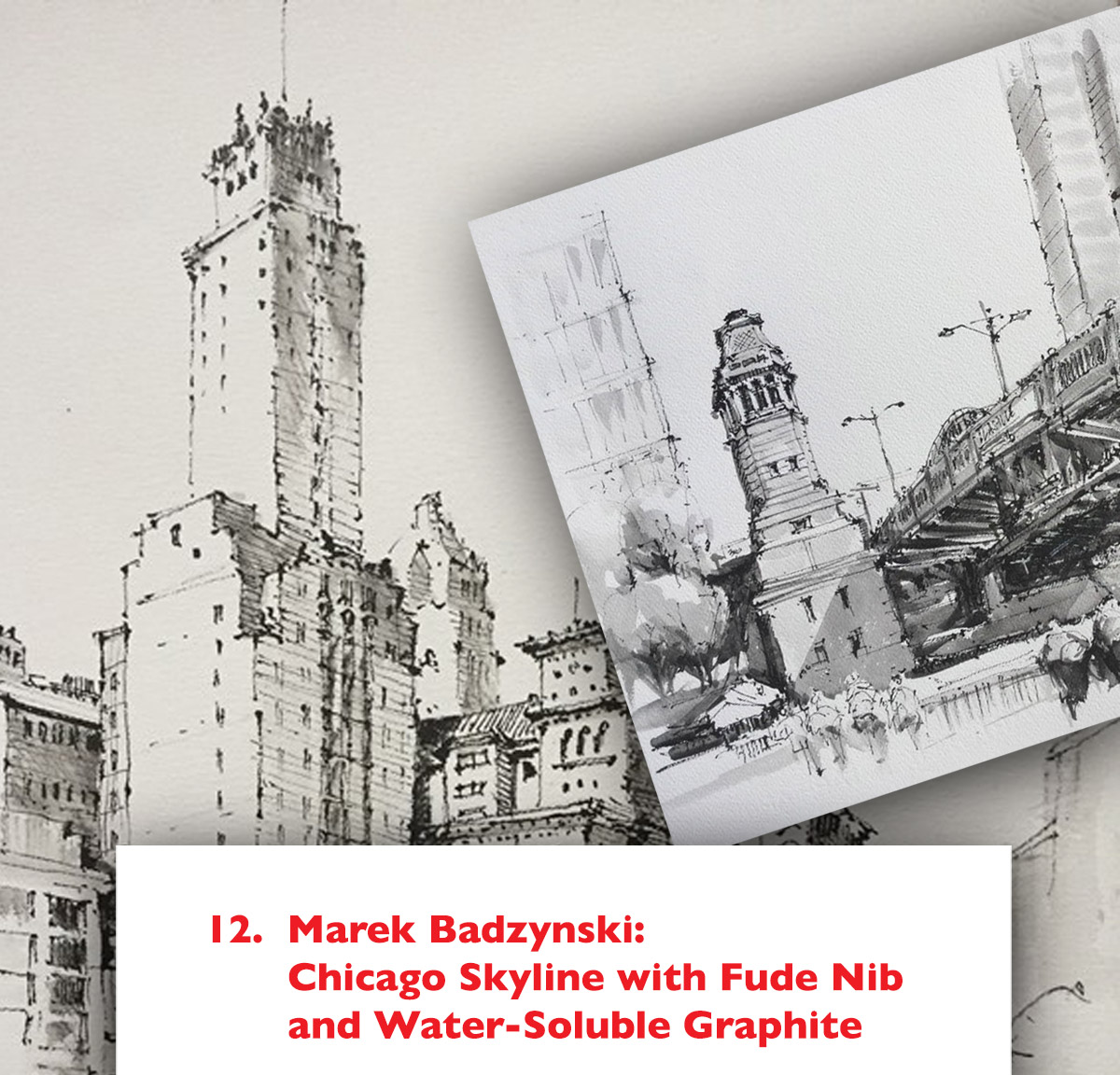
Participants will create a sketch in ink outline using a fountain pen, then add monochrome tones of water-soluble graphite. A light pencil undersketch may be used.

Participants can use any fountain pen they bring, or choose from a variety of fountain pens provided for the workshop by the instructor. Several of those pens have a Fude-style bent nib, excellent for calligraphy and expressive sketching. Fude nib has the ability to lay down both thick and thin lines, and to vary them accordingly to the angle & direction nib touches paper. This results in expressive, variable lines.

LEARNING GOALS

  • Identify masses; 
  • Simplify/exclude elements to speed up drawing process;
  • Assess values according to light conditions;
  • Ink shapes of similar value;
  • Draw ink lines with expressive, variable stroke;
  • If using fude, learn to control line thickness by nib angle and direction;
  • Identify and concentrate attention on focal point area;
  • Experience use of fude nib

SUPPLY LIST

  • One 1/4 sheet of watercolor paper, any brand, weight and texture. Cold press / rough 140# weight is preferred
  • Pencil, sharpener and pencil eraser, any hardness;  anything  2B–H, or a standard No2 pencil, will do
  • Fountain pen with standard nib, or with Fude nib. Larger sized nibs (medium-bold) preferred. A number of fountain pens will be available for testing during the seminar. While this seminar lists Fude in its title, some sketchers may prefer to use a standard nib – but at least they tried..
  • Fountain pen ink: any waterproof ink that works with your fountain pen. Brands include Platinum Carbon (my own choice), Noodler’s Bulletproof inks, De Atramentis Document, and few others. Do not use India ink in fountain pens!
  • Water-soluble graphite: LYRA solid graphite watersoluble stick, or any other source of solid soluble graphite (Derwent, Viarco..). Instructor will distribute pieces of LYRA stick for use.
  • Water source: small jar or (spray) bottle to wet graphite stick pan
  • Brush: any size/style brush capable of picking up wet (graphite) paint; typical watercolor brush will do, larger size is preferred so graphite washes can be laid with a “one-stroke”, or just few repetitions
  • Support board, folding seat, sun hat, water bottle… and your usual  sketchers paraphernalia

Workshop 11

INSTRUCTOR

Lisa Flahive

DESCRIPTION

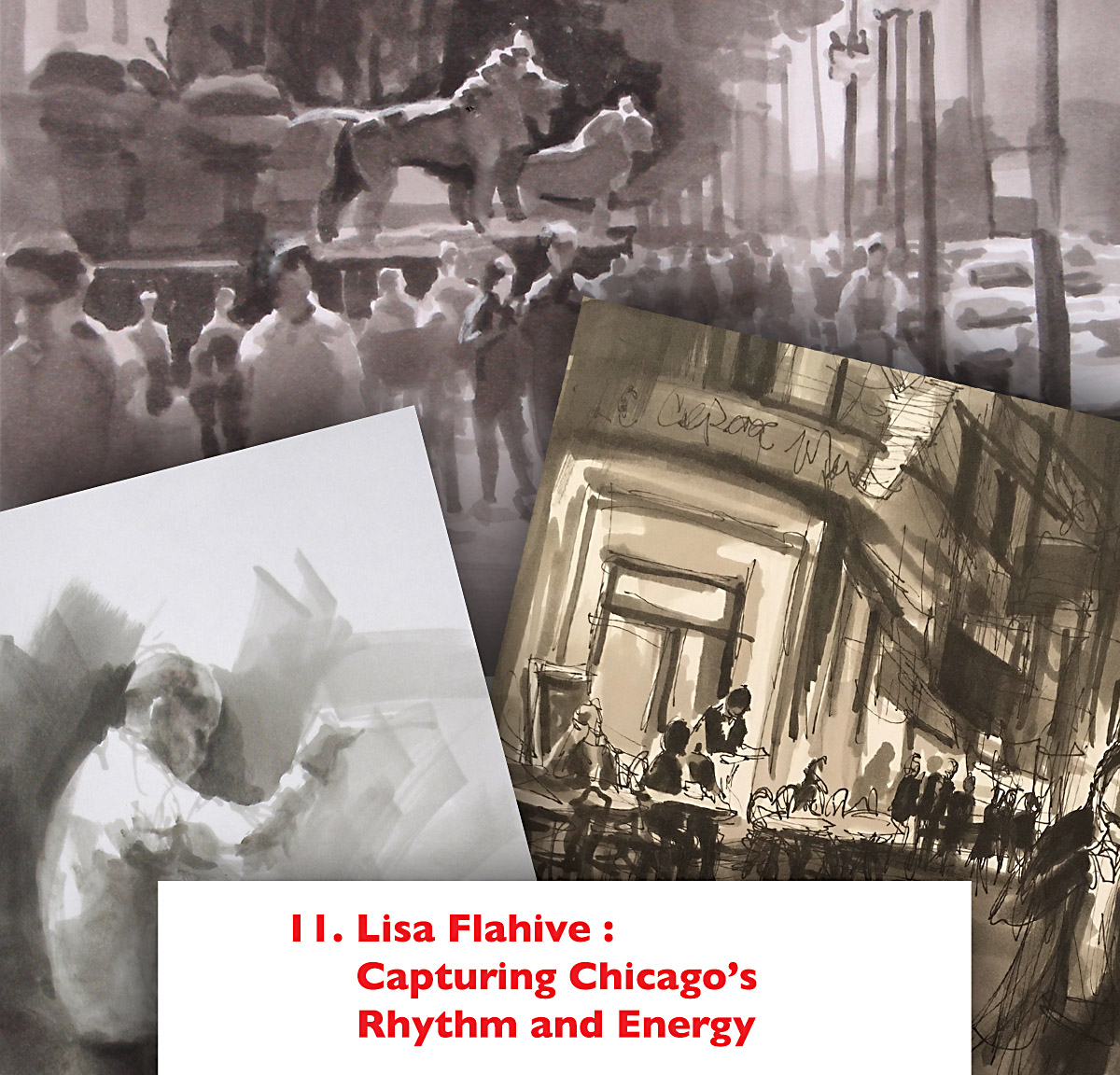
Chicago is a vibrant city overflowing with wonderful things to sketch, but sometimes those details can be overwhelming, especially when working in ink. This workshop will focus on creating energetic sketches of lively urban spaces without an eraser.

We’ll use bold greyscale markers to loosen up and lessen our fears. We will experiment with loose, flowing lines to get a sense of what Chicago feels like, rather than get bogged down in excessive detail.

LEARNING GOALS

Participants will learn to confidently capture the energy of a street by using

  • Dynamic composition with a focal point
  • Line and shape
  • Strong sense of value
  • Connected shapes to unify the sketch

SUPPLY LIST

  • Sketchbook
  • One or more technical pens (black ink)
  • Markers – black and two or more gray values (the instructor will demonstrate with Copic Wide Markers and Pitt Big Brush markers but participants may bring any sketching material that allows them to create a range of values.)

Workshop 10

INSTRUCTOR

John A Hancock

DESCRIPTION

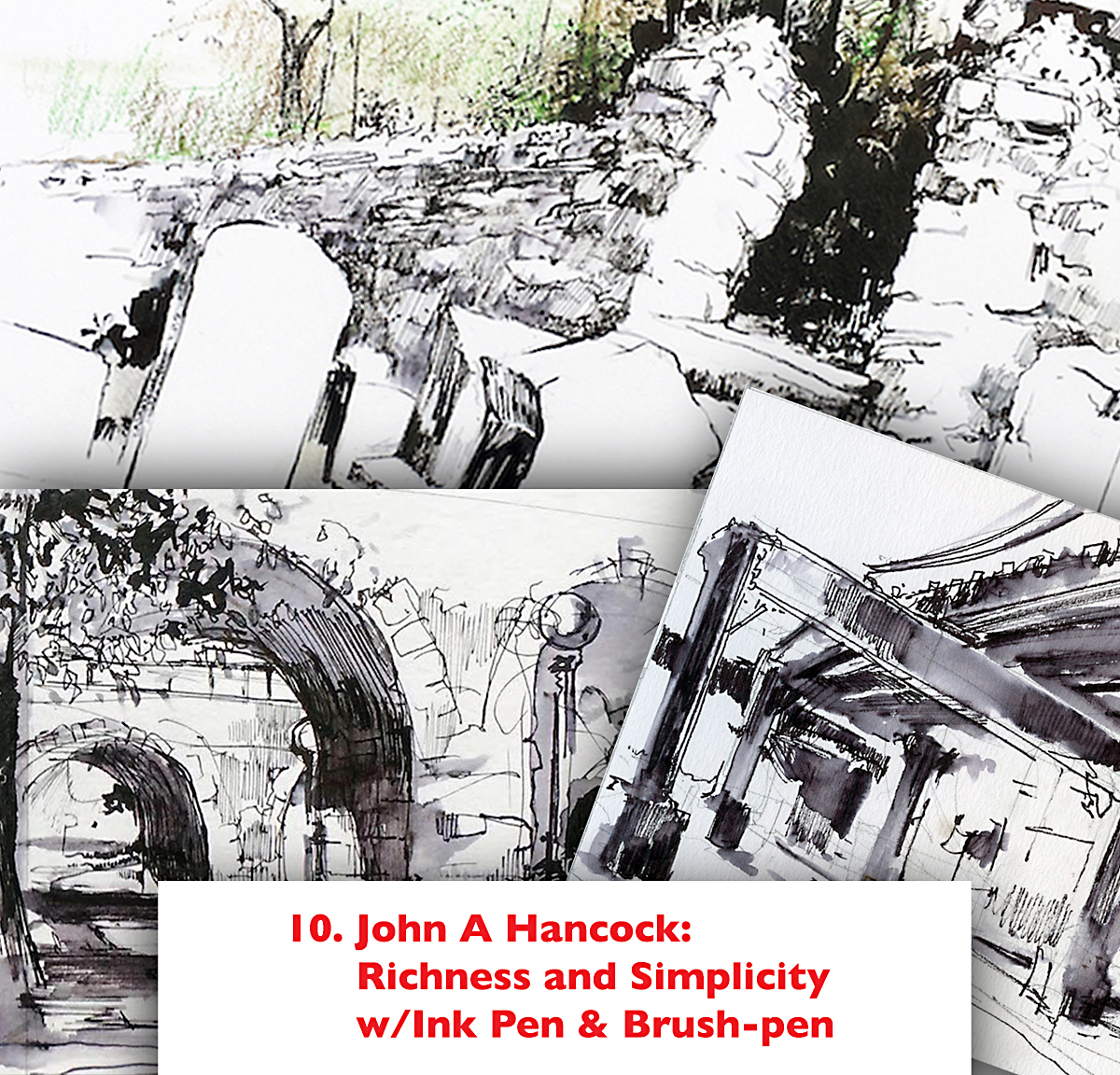
The workshop will start with a quick introduction to choosing our subject and point of view while embracing both visual richness and simplicity.  Working in a location with architecture, people, and possibly plants/trees, you will learn techniques for quick ink-based sketching, using both permanent and water-soluble inks for line, texture, and washes. 

LEARNING GOALS:

In this workshop, participants will

  • learn to choose/edit a view from the location and start their sketch;
  • learn basic techniques for using both permanent and water-soluble pen and brush-pen inks; and
  • Explore strategies that balance visual richness with simplicity in sketches of the urban environment.

SUPPLY LIST

When I introduce a class to the topic of using permanent and water-soluble inks, I usually give away two very common cheap pens … an ultra fine point Sharpie and a Flair felt tip pen. For the workshops perhaps more experienced sketchers, I would suggest:

  • Your favorite permanent (not water-soluble) ink pen:  a Pitt pen, a Micron, or even a fountain pen with a permanent ink like Platinum Carbon Black or Lexington Grey 
  • Your favorite pen that uses a water-soluble ink: Pilot Varsity, Platinum Preppy, etc.
  • A Pentel Pocket Brush Pen
  • A water-brush (round tip) or a round watercolor brush and water  
  • Sketchbook or sketch paper that can handle moderate applications of water
  • Optional: a favorite standard or mechanical pencil and an eraser
  • Optional: wet or dry color to add to your sketch afterwards

Workshop 9

INSTRUCTOR

Joann Harling Larsen

DESCRIPTION

Part of what makes an urban landscape so unique is the people, but drawing people can be intimidating.  Let’s “face” this, together!  This workshop will look at capturing people – not their specific appearance, but their energy and gestures.  As humans, we occupy space.  We have weight, form, and movement. In this workshop, you will engage in drawing exercises that focus on isolating each of these elements. How do we incorporate and capture these ideas into a drawing?  You will then use some Play-Doh modeling clay to help visualize heads and faces as forms in light, and study foreshortening by considering simplified facial features from different points of view.  You will then return to drawing, incorporating insights from each of the exercises into sketching people into your landscapes.

LEARNING GOALS:

In this workshop, participants will

  • practice focusing on the content of the drawing rather than the subject;
  • learn to capture the energy, gestures, and presence of people; and
  • explore foreshortening of people and sketching people in a scene.

SUPPLY LIST

  • Drawing materials of choice (for example: pencil, charcoal, inks, sketchbook)

Workshop 8

INSTRUCTOR

Jingo de la Rosa

DESCRIPTION

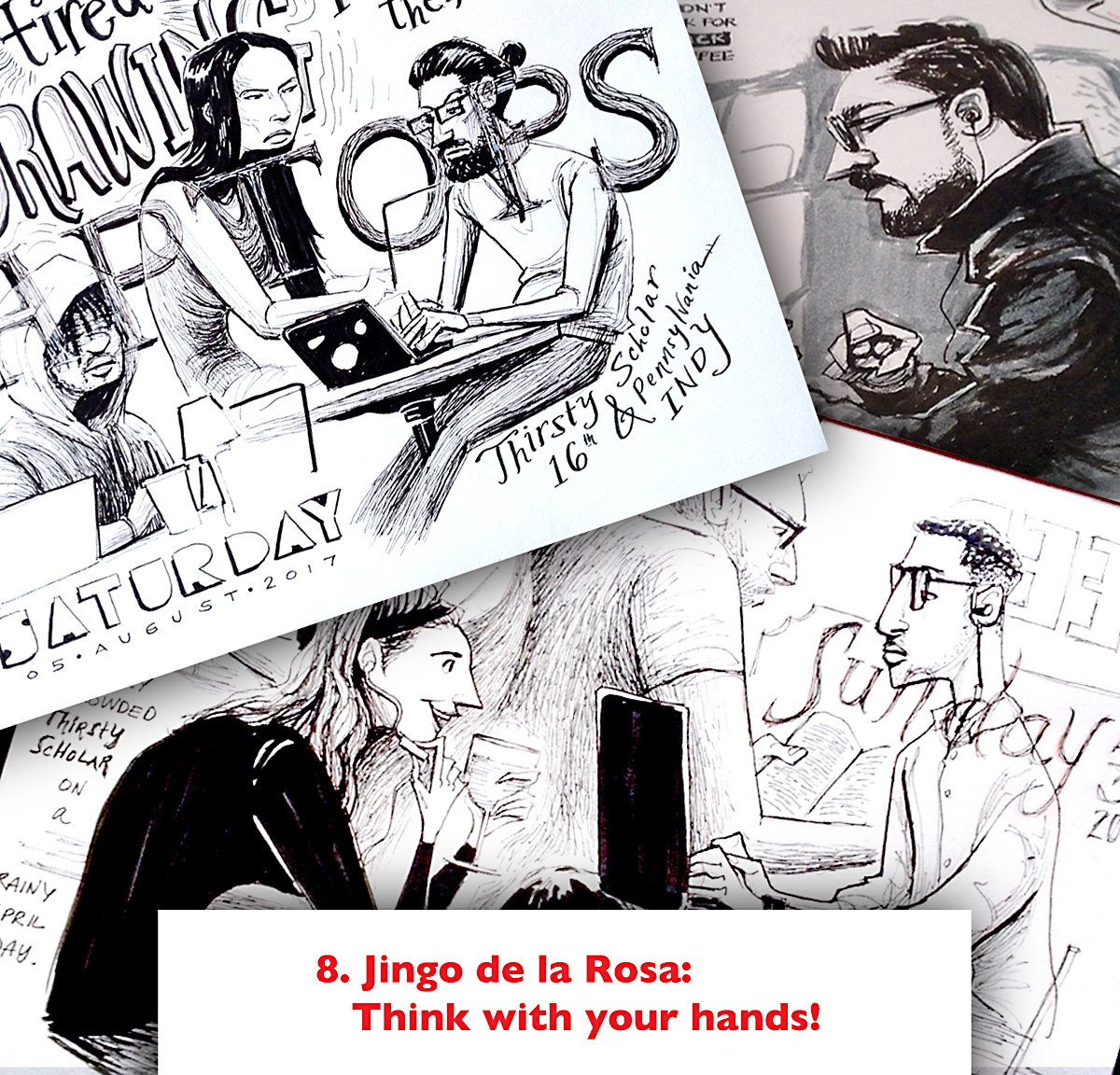
Some of us like structure, especially when sketching. This workshop is all about setting that inclination aside, and creating beautifully-composed sketches without planning the composition!  You will also be encouraged to draw without the initial pencil sketch.  To help you become more comfortable sketching in this way, this class combines demonstrations with time to practice.  The first demonstration will showcase drawing techniques including blind contour and contour drawing, followed by an observational sketching practice session.  The second demonstration focuses on drawing refinement and composition.  You will then have more time to practice these techniques in the field.

LEARNING GOALS

In this workshop, participants will

  • learn to let go, and let their hands do the thinking;
  • learn to trust their instincts rather than depending on structure;
  • practice drawing loosely first and refine later;
  • experiment with different pen and ink techniques; and
  • learn how to cover up mistakes.

SUPPLY LIST

  • Inking pens in different sizes (for example: Microns 01, 05, and 08)
  • Sketch book(s)
  • Optional: Markers, watercolor

Workshop 5

INSTRUCTORS

Brian Wright & Suzala Zahler

DESCRIPTION

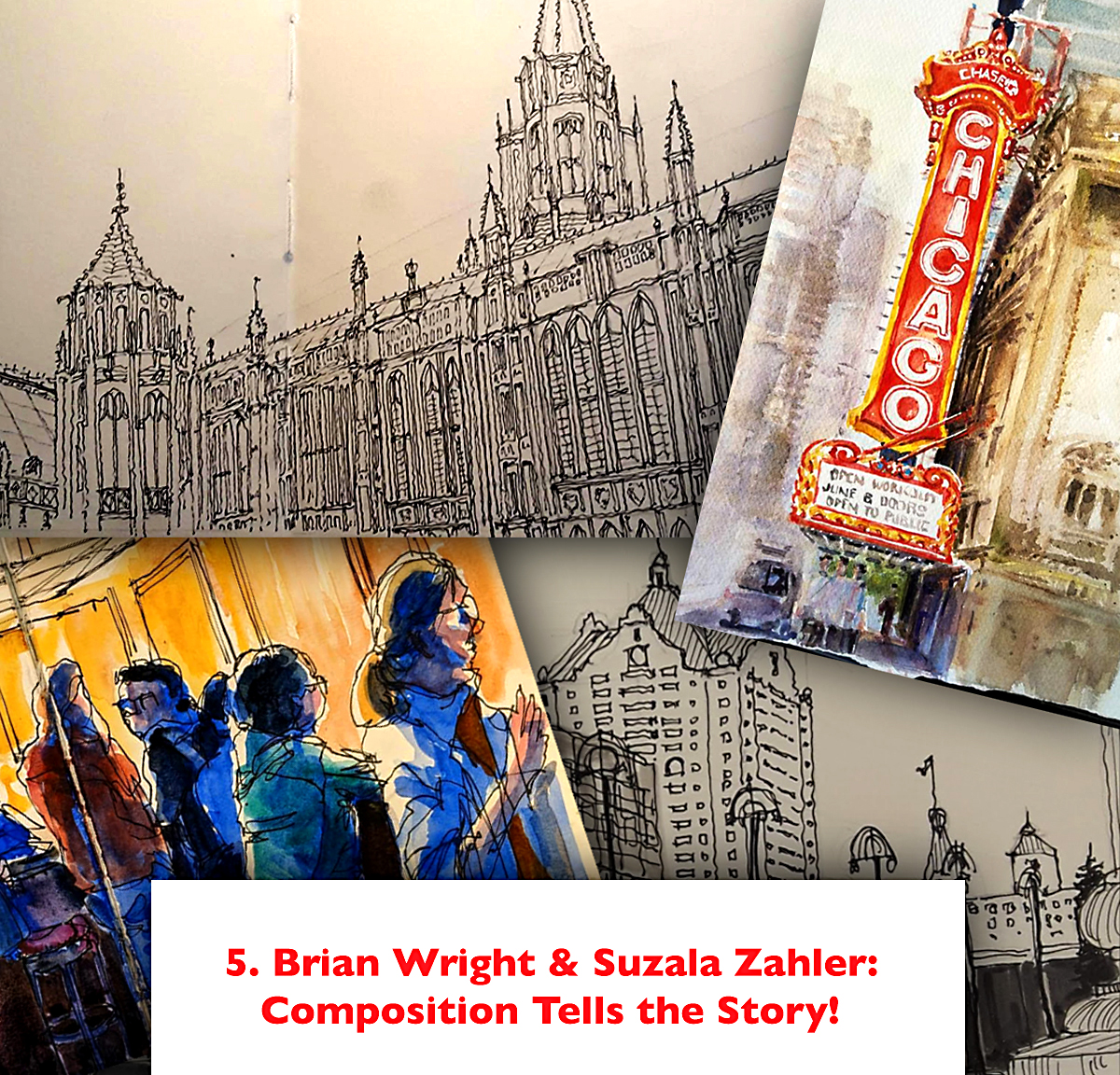
A good painting is one that tells a story, such as, “It was a beautiful spring day,” or “The streets were very wet,” or “It was late afternoon and the shadows were beautiful.”   In defining the focal point, you draw the viewer in, guide them through the painting, and make sure they don’t wander off the page and out of the story.  This workshop explores some simple design techniques to help you tell a story with each sketch.  Composing your sketch effectively can make the difference between a good sketch and one that can transcend the media.  Learning and practicing the art of arranging elements in a sketch will help you achieve a well balanced result and elevate your work to a new level!

LEARNING GOALS:

In this workshop, participants will learn composition techniques including:

  • Rule of Thirds:  a great technique that focuses the viewer toward a balanced drawing;
  • Golden Proportion:  used for centuries by artists, this technique helps create a more harmonious drawing;
  • Leading Lines:  this technique draws the viewer’s eyes towards your focal point;
  • Strong Diagonal:  a dynamic view angle can help tell a unique story; and
  • Framing:  a dynamic crop can help direct the viewer to what you want them to focus on, your “center of interest”.

SUPPLY LIST

  • Sketchbook of your choice
  • Sketching tools of your choice

Workshop 4

INSTRUCTOR

Barbara Weeks

DESCRIPTION

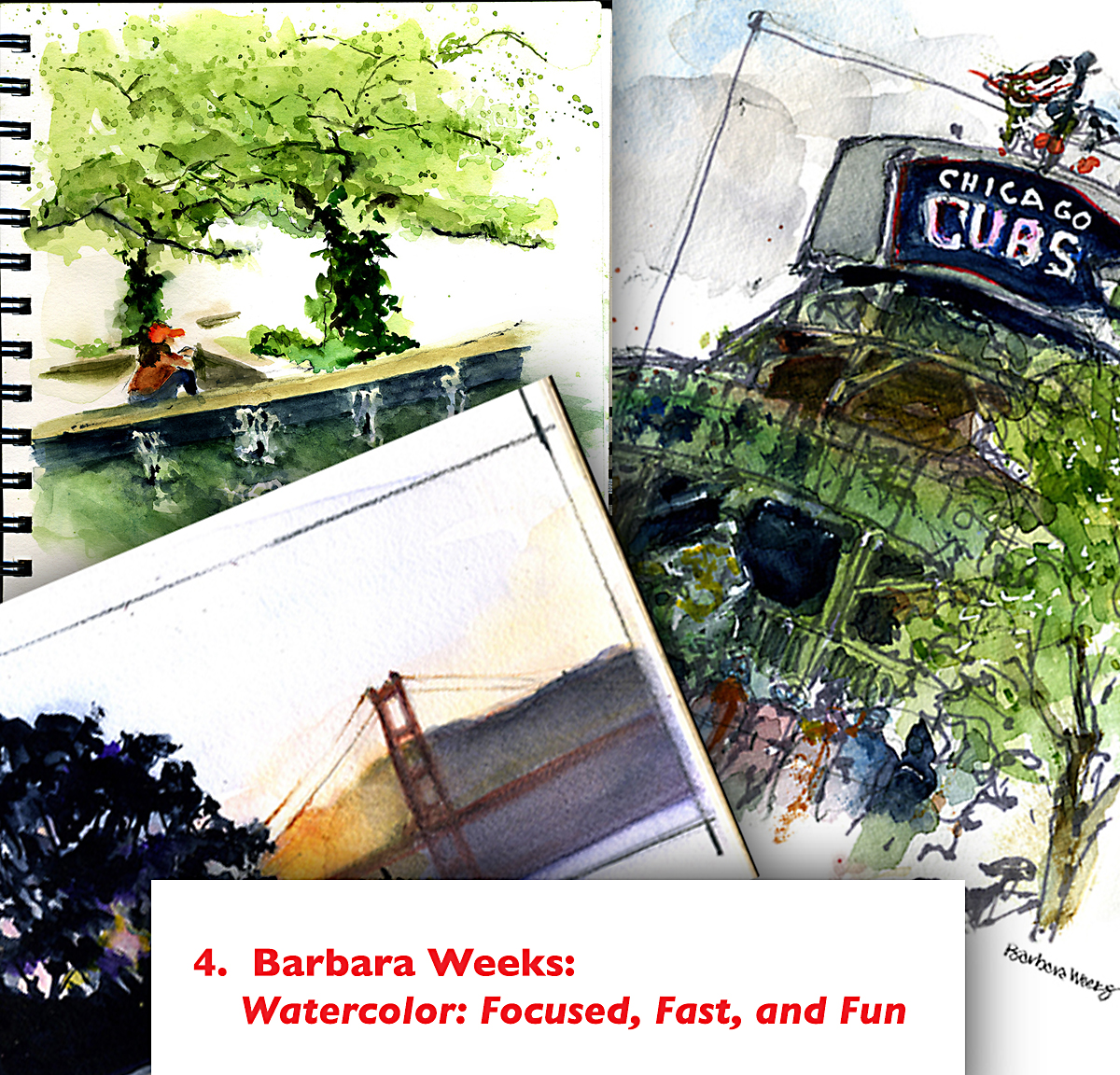
Watercolor has a reputation for being a troublesome or intimidating medium. This workshop seeks to offer an alternative experience and put the fun in watercolor!  Through demonstrations and exercises, you will explore ways to add life to your sketches by playing with values and color and letting the paint do most of the work.  Specifically, this workshop focuses on creating a range of values with watercolor, choosing watercolor hues, and sketching with watercolor.

LEARNING GOALS:

In this workshop, participants will

  • learn how water and the paint can work and play together to create value and color;
  • explore creating values in watercolor;
  • choose hues in their pallet that play nicely together; and
  • learn a few simple tricks to help enjoy the process

SUPPLY LIST

  • Watercolor or Mixed Media Sketchbook (at least 5.5 x 8.5 inches or larger)
  • Watercolors and brushes/waterbrush
  • Pencil (2B or 3B) 
  • Small spray bottle
  • Paper towels, tissues, or rag for blotting


Workshop 3

INSTRUCTOR

Amy Larsen

DESCRIPTION

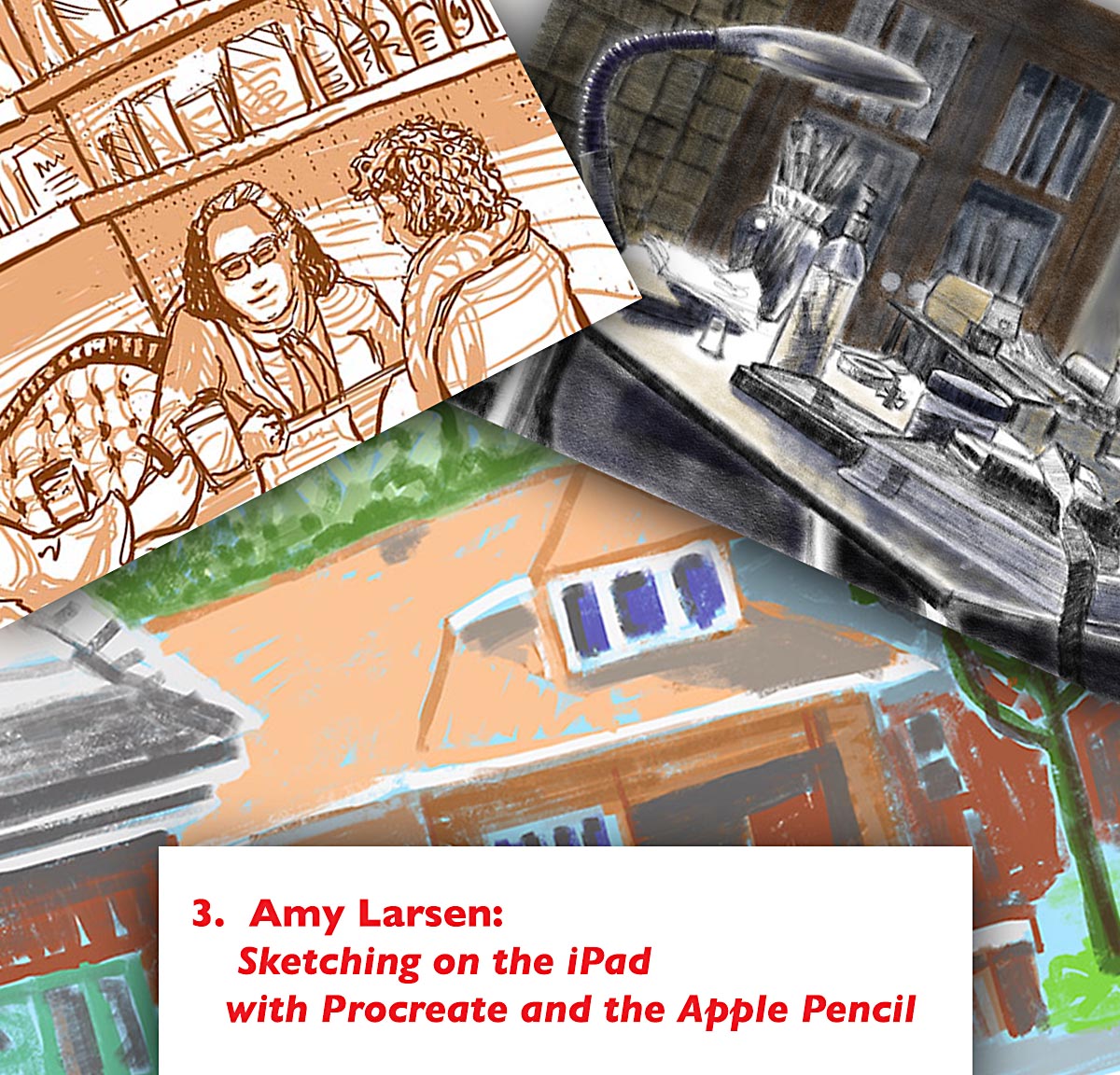
Are you ready to improve your skill in sketching on the iPad with Procreate and the Apple pencil?  By employing tools and techniques that are particularly valuable for sketching, this workshop will take you from a beginner to an advanced skill level.  Specifically, this workshop will cover:

  • Reasons and strategies for using layers;
  • Brushes (recommended brushes, modifying brushes, and creating new brushes);
  • Blending modes;
  • The adjustments menu;
  • Perspective grids, assisted drawing, and the drawing guide;
  • How to make shapes and straight lines; 
  • Gestures, picking colors, color filling, and making color palettes;
  • and much more!

LEARNING GOALS

In this workshop, participants will

  • gain confidence using Procreate for sketching;
  • learn how to make custom brushes; and
  • learn the most useful gestures and tools to make using the app quick and easy.

SUPPLY LIST

  • Apple iPad
  • Procreate App
  • Apple pencil

Please note, the workshop will NOT provide technology for participant use.